T.R.M. (Thyroidman Clinic) Bangkok,Thailand

Thyroid treatment services

All types of thyroid and parathyroid surgery

by Dr. Thanyawat, Endocrine surgery (Thyroid and Parathyroid)

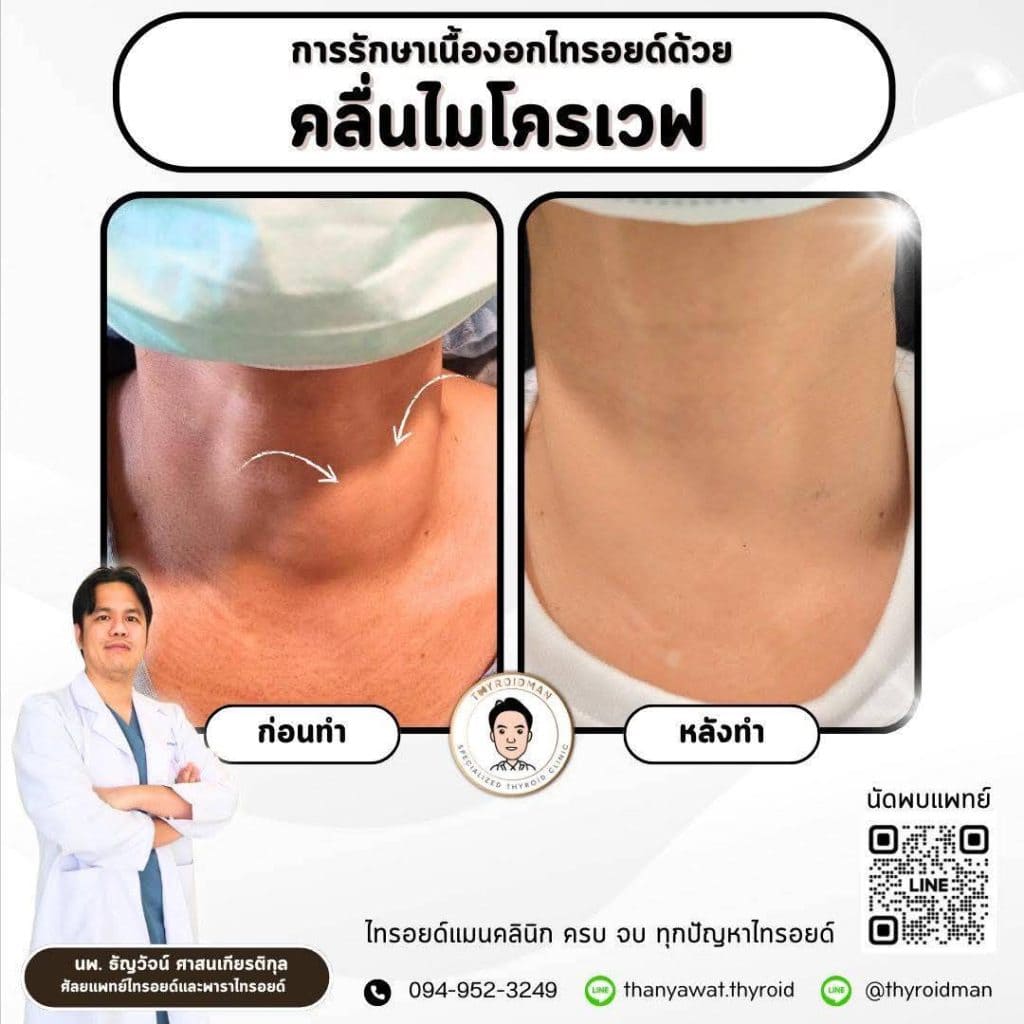
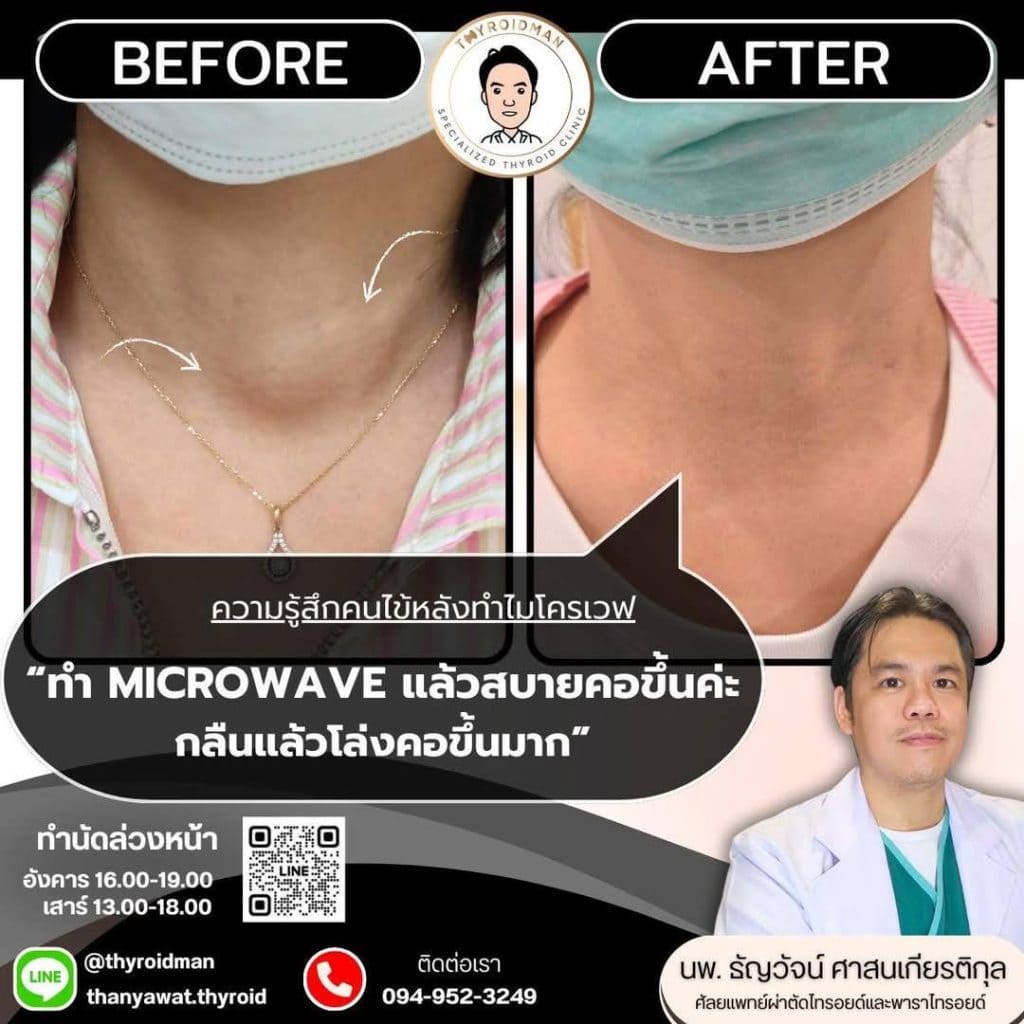
Microwave ablation thyroid nodule

A New Alternative: No Surgery, No Scarring

When discussing the treatment of a “thyroid tumor,” most people imagine entering a major operating room, undergoing general anesthesia, and coming out with surgical sutures on their neck or inside their mouth. While those methods are safe and effective, losing healthy thyroid tissue or undergoing surgery remains a major concern and a source of anxiety for many patients.

Today, medical innovation offers a way to break through those fears with Microwave Ablation (MWA) for thyroid tumors. This is a non-surgical procedure that uses merely a small needle precisely directed at the tumor to destroy it. This article will take everyone into a deep dive on this cutting-edge innovation in the simplest language possible.

How Do Microwaves Treat Tumors?

When hearing the word “microwave,” many people might picture a home kitchen oven and wonder if that same technology can really be used inside the human body. The core principle is actually very similar!

Just as a microwave oven emits waves to vibrate water molecules in food to generate heat, MWA utilizes the same concept. A specialized, ultra-fine needle is inserted through the skin of the neck directly into the tumor. Once in position, microwave energy is emitted from the tip of the needle, causing water molecules within the tumor tissue to vibrate and generate high heat—around 60°C to 100°C. This targeted thermal energy causes the tumor cells to shrink and die (**Thermal Coagulation**) while keeping the surrounding healthy thyroid tissue unharmed.

After the tumor cells die, the body’s natural immune system (such as white blood cells) gradually clears away the cellular debris. As a result, the tumor continuously shrinks in size over the months following the procedure.

5 Key Advantages That Make MWA an Attractive Option

When compared to traditional surgery, microwave ablation offers several distinct benefits:

  • No Neck Scars:
    Because only a fine needle is inserted, the entry point is no larger than a tiny pinhole. Afterwards, a small adhesive bandage is applied, and the mark fades away within a few days without leaving a scar.
  • No General Anesthesia Required:
    This procedure requires only local anesthesia around the thyroid gland. You remain fully conscious throughout the procedure and can converse with your doctor, eliminating the risks and recovery associated with general anesthesia.
  • Preserves Healthy Thyroid Tissue:
    Conventional surgery often requires removing half or all of the healthy thyroid tissue. MWA targets and destroys only the tumor itself, allowing the remaining healthy thyroid tissue to function normally. As a result, patients do not need to take lifelong thyroid hormone replacement therapy.
  • Minimal Pain, Rapid Recovery, No Hospital Stay:
    The procedure takes only about 30–60 minutes. After a brief 1–2 hour observation period at the hospital, you can walk home, board a flight, or resume your daily routine immediately as an outpatient (day-case) procedure.
  • High Safety Profile with Reduced Risk of Hoarseness:
    Doctors use real-time ultrasound guidance throughout the procedure to visualize both the tumor and the needle tip. This precise targeting allows them to safely navigate around key structures, protecting the recurrent laryngeal nerves that control your vocal cords.

Who is a Suitable Candidate for MWA Treatment?

Although it may sound like an ideal solution, MWA has specific indications and is suitable only for select patient groups, including:

1. Patients with Benign Thyroid Nodules:
Nodules that have been confirmed non-cancerous through fine-needle aspiration (FNA) biopsy at least 1 to 2 times.

2. Patients with Symptomatic or Enlarging Nodules:
This includes nodules that bulge noticeably and affect self-confidence, or those large enough to cause compressive symptoms—such as difficulty swallowing, a feeling of tightness in the throat, or discomfort when lying flat.

3. Individuals Who Wish to Avoid Surgery or Have Surgical Contraindications:
This includes elderly patients or individuals with severe underlying medical conditions that make long-duration general anesthesia unsafe.

Note:

For thyroid cancer, traditional open surgery or endoscopic resection remains the primary standard of care. MWA may only be considered under exceptional circumstances, such as very small microcarcinomas in patients who are genuinely unfit for surgical intervention.

Preparation and Self-Care Steps

The procedure for MWA is straightforward and uncomplicated:

Before the Treatment Day:

  • Blood Tests:
    Blood work is performed to check your blood clotting function.
  • Medication Disclosure:
    Inform your doctor of all regular medications, particularly blood thinners (anticoagulants), which must be temporarily stopped about 5–7 days prior under medical supervision to prevent bleeding.
  • Fasting:
    Although general anesthesia is not used, you may be instructed to fast from food and drink for about 2–3 hours beforehand for safety precautions.

On the Treatment Day and During the Procedure:

  • Positioning & Local Anesthesia:
    You will be positioned lying flat on your back with a pillow under your shoulders to keep your neck extended. A local anesthetic is then injected into the neck area.
  • Ablation Process:
    The doctor inserts the microwave needle under real-time ultrasound guidance. Once the needle tip is accurately positioned, thermal energy is delivered. During this process, you may feel a slight warm or heavy sensation in your neck; if you experience any pain, you can immediately inform the doctor to receive additional local anesthetic.

Home Care and Recovery

  • Puncture Site Care:
    Do not let the puncture wound get wet for the first 48 hours. After this period, you can safely remove the adhesive bandage and shower normally.
  • Dietary Guidelines:
    You can resume eating a normal diet immediately after the procedure. However, if your neck feels slightly sore, sticking to soft and bland foods for the first 1–2 days is recommended.
  • Follow-Up and Monitoring:
    It is important to note that the tumor will not vanish instantly right after the treatment is finished. Instead, it will gradually wither and shrink over time. Typically, the nodule’s volume will reduce by about 50–80% over the course of 6–12 months. Your doctor will schedule periodic ultrasound appointments to carefully monitor this reduction in size.

Summary

Microwave ablation (MWA) for thyroid tumors represents a major milestone in medical technology, turning thyroid treatment into a far gentler, more comfortable experience. It is an ideal solution for patients with benign nodules who wish to avoid surgical scarring, skip hospital stays, and preserve their long-term thyroid function.

If you have been diagnosed with a thyroid tumor and are exploring treatment options, consider discussing MWA with a specialist to evaluate whether your tumor profile is suitable for this incisionless innovation. Selecting the approach best tailored to your individual needs is the ultimate key to a smooth and successful recovery.